
SEPTEMBER 1, 2026
4 min read
How many dogs can a solo groomer do in a day?
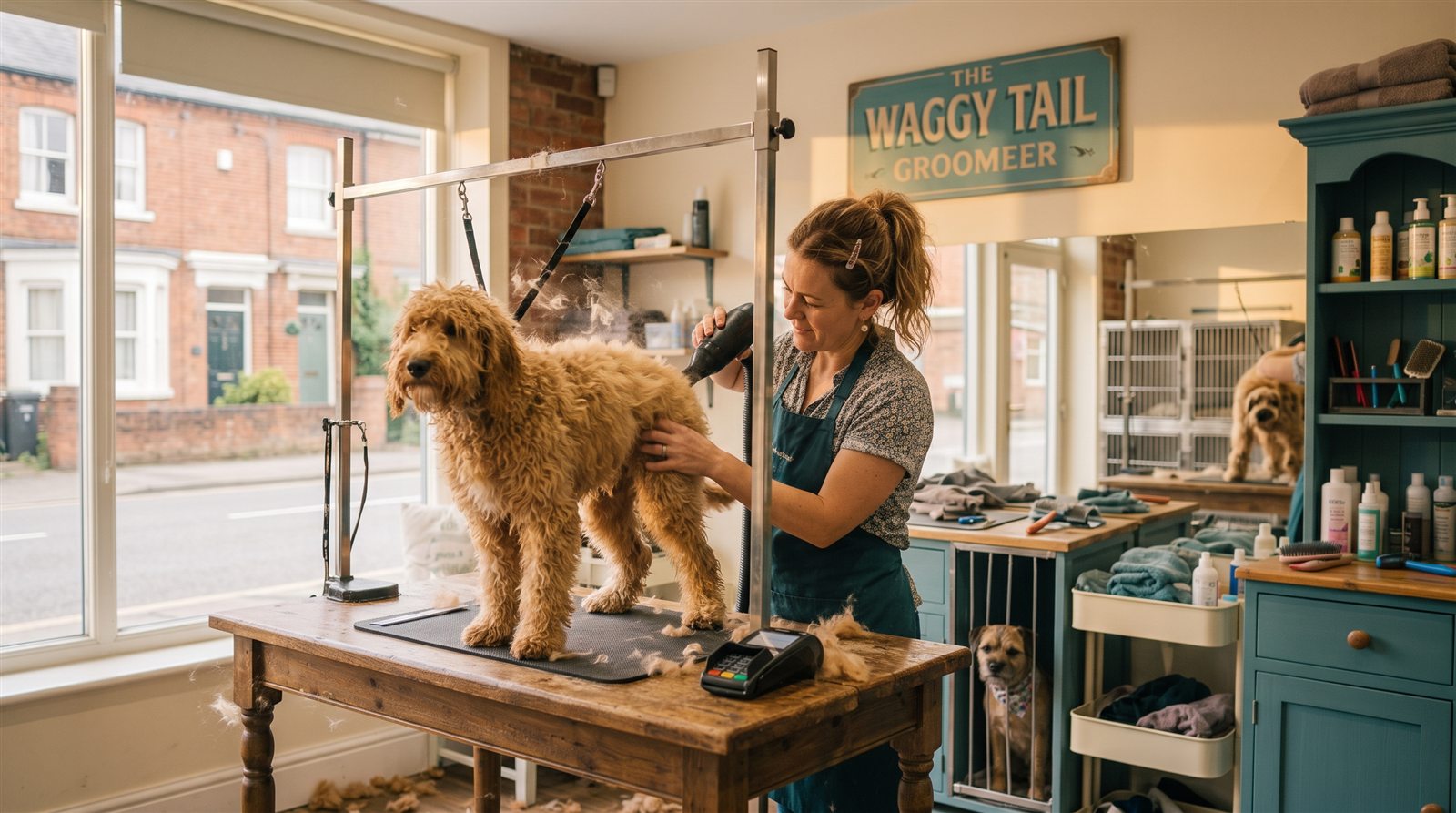
Photo: japanese_craft_construction, CC BY 2.0, via Wikimedia Commons (cropped)
A working day measured in minutes
Working alone and doing the whole dog, you can fit three to eight dogs in a day, depending on the coats you've booked. This guide shows that arithmetic, then covers capacity measured in revenue, what the work does to your body, and when a full book means it's time to raise prices.
The minutes below are the starting times in FurSlot's breed table (September 2026), plus 10 minutes a dog for check-in, the checkout conversation and wiping down the table. The standard doodle gets 3.5 hours, the top of Dapper Doodle Grooming's 2026 estimate, because a long doodle groom is what makes a day run over.
| Day | Dogs | Table minutes | With 10 minutes a dog |
|---|---|---|---|
| Small-dog baths: four Beagles at 40 minutes, four Pugs at 45 | 8 | 340 | 420, seven hours |
| Mixed: a Shih Tzu (90), a Mini Goldendoodle (110), a Labrador (110), a Beagle full groom (55), a Pug bath (45) | 5 | 410 | 460, just under eight hours |
| Heavy: a standard doodle (210), a Newfoundland (190), a nail trim (15) | 3 | 415 | 445, about seven and a half hours |
Twelve 40-minute baths plus handovers come to 600 minutes, or ten hours, before you've done a single full groom, so a twelve-dog day needs a bather. Without a bather, you fit each checkout conversation into the same eight hours as the grooming.
Plan the day by revenue
Measure the day in dogs and you'll drift toward the wrong bookings. Say you charge $45 for a bath and $95 for a full groom. Five baths bring in $225 for a long, wet day, while three full grooms bring in $285 with fewer handovers and a schedule that runs on time. QC Pet Studies' 2026 price guide lists large dogs at $70 to $120 and doodles at $80 to $150 and up, so the day with fewer dogs often earns more.
Set a daily revenue target and work backward. With a $400 target, you stop counting dogs and plan the mix of grooms that reaches $400 inside eight hours. To reach it without a ninth dog, set each groom's price from its minutes, using how to price dog grooming.
Pain data from 180 pet groomers
Your body sets the limit on daily volume, and researchers have now measured the strain. In a 2026 study in the journal Healthcare, they surveyed 180 pet groomers in Taiwan. Ninety-five percent reported a musculoskeletal problem somewhere in the past year: 71.7 percent in the right shoulder, 70.6 percent in the neck, 65.6 percent in the lower back and 57.2 percent in the right wrist or hand. They averaged 8.9 hours a day, and those bathing more than 21 pets a day reported more pain.
Plan each day so your body holds up:
- Book heavy dogs in the morning, while you're fresh.
- Take a seated lunch break instead of eating a granola bar over the tub.
- Leave one afternoon slot open. You'll need it for the dog that arrives matted, and on a day without one you can use it for callbacks or leave on time.
- Get a ramp or a lift table for big dogs before you hurt your lower back lifting them.
When the day starts running late
You'll still run late on a well-planned day when a coat is worse than booked. Check the clock at the halfway point of each groom, and if you're more than 20 minutes behind by then, text the next client right away, while they can still change plans:
"Hi [name], the groom before yours is taking longer than planned. Could you bring [dog's name] at [new time] instead of [old time]? If that doesn't work, come at [old time] as planned and pickup will just run a little later."
That message works because you send it early and give the client a choice instead of an apology. If you wait until drop-off time to send it, the client has to rearrange their afternoon around your delay.
If a breed runs over its slot two visits in a row, lengthen that breed's slot and reprice it from the minutes you spent.
Two no-shows in an eight-dog day
A packed book with two no-shows earns no more than a modest book where all the booked dogs arrive. If you book eight and two don't show, you groom six dogs on a broken-up day with a 2pm gap you couldn't fill. With a book of six where all six arrive, you groom the same six dogs without that disruption.
Before adding a seventh slot, make the six you have dependable. Send reminders the day before and put your cancellation window in writing. Take a deposit from new clients too, sized with the deposit guide. Use the no-show calculator to put a yearly dollar figure on what your misses cost now, and find the rest of the playbook in how to stop no-shows.
Pricing a book that stays full
If you've been full for months, raise prices before you touch the schedule. On a 10 percent raise, one divided by 1.10 is 0.909, so you can lose about 9 percent of your clients and still take in the same revenue. Lose a full 10 percent and you're 1 percent behind (1.10 times 0.90 is 0.99), with a tenth of your table hours back. Clients who leave over a $5 increase tend to be the least attached to begin with.
Don't hire a second groomer to protect prices that are too low. Raise them first, and if you're still turning away dogs you can't fit, weigh a second table then. You'll find current ranges in the 2026 pricing guide.
References
FAQ
How many dogs should a new solo groomer book per day?
Start at four or five and work up. You get faster through repetition, and if you overbook the first month you'll rush grooms and collect bad reviews. Add the sixth dog when the fifth stops feeling tight.
How long does a full groom take for one groomer?
Dapper Doodle Grooming's 2026 guide puts a Labrador or Beagle at 60 to 90 minutes and a standard doodle at 2.5 to 3.5 hours. The coat's condition pushes the time up or down, so time your own grooms for two weeks and book from those numbers.
Is it better to do more baths or more full grooms?
Full grooms tend to earn more per hour once your scissor work is solid, and clients rebook them on a steadier cycle. Baths work well as filler between grooms and as an entry service for new clients.
Should I take walk-ins as a solo groomer?
Only into a slot that was already empty. If a walk-in pushes a booked client into overtime, you're risking a loyal client to serve a stranger. Keep a short list of regulars who'd like an earlier date, and you can fill the same gap with less risk.